Home › Services › Breaker Keeps Tripping
A breaker exists to open the circuit before the wiring behind the wall gets hot enough to matter. When one keeps going, it is telling you something specific, and which of four things it is can usually be narrowed down before anyone arrives.
Overload. Too much load on one circuit. It trips after minutes rather than instantly, it correlates with what you switched on, and unplugging something fixes it. The classic Sugar Land version is a 1978 garage circuit now carrying a freezer, a second refrigerator and a shop compressor.
Short circuit. A hot conductor touching a neutral or a ground. It trips instantly and repeatably, often with a bang or a flash, and resetting does nothing. This is not a wait-and-see condition.
A ground fault. Current escaping the circuit to ground — frequently moisture in an exterior box, a pool or spa circuit, or a failing appliance. Very common here in the wet months, and it usually trips a ground-fault device rather than the breaker itself. The December version of this has its own page: Christmas lights tripping the breaker.
A failing breaker. Real, and last on the list on purpose. Breakers are mechanical and they age, and one that has tripped many times can become sensitive. Reaching for this explanation first is how genuine faults get left in the wall.
This is the most common seasonal complaint in this market and it has a mechanical explanation. An air conditioning compressor draws several times its running current for a fraction of a second at startup. On a healthy, adequately sized service that inrush is unremarkable. On an original 100A or 150A service in Sugar Creek or Covington Woods, in a house that has since added a second system, it is the moment everything else is nearest the edge.
Which means the question is genuinely two questions: is the electrical service the constraint, or is the equipment drawing more than it should because something in it is failing? A weak capacitor or a struggling compressor pulls harder at start, and that shows up at the panel as a tripping breaker. It is worth settling that before either the panel or the condenser gets replaced — see panel upgrades, and the condenser-side diagnosis for the other half of it.
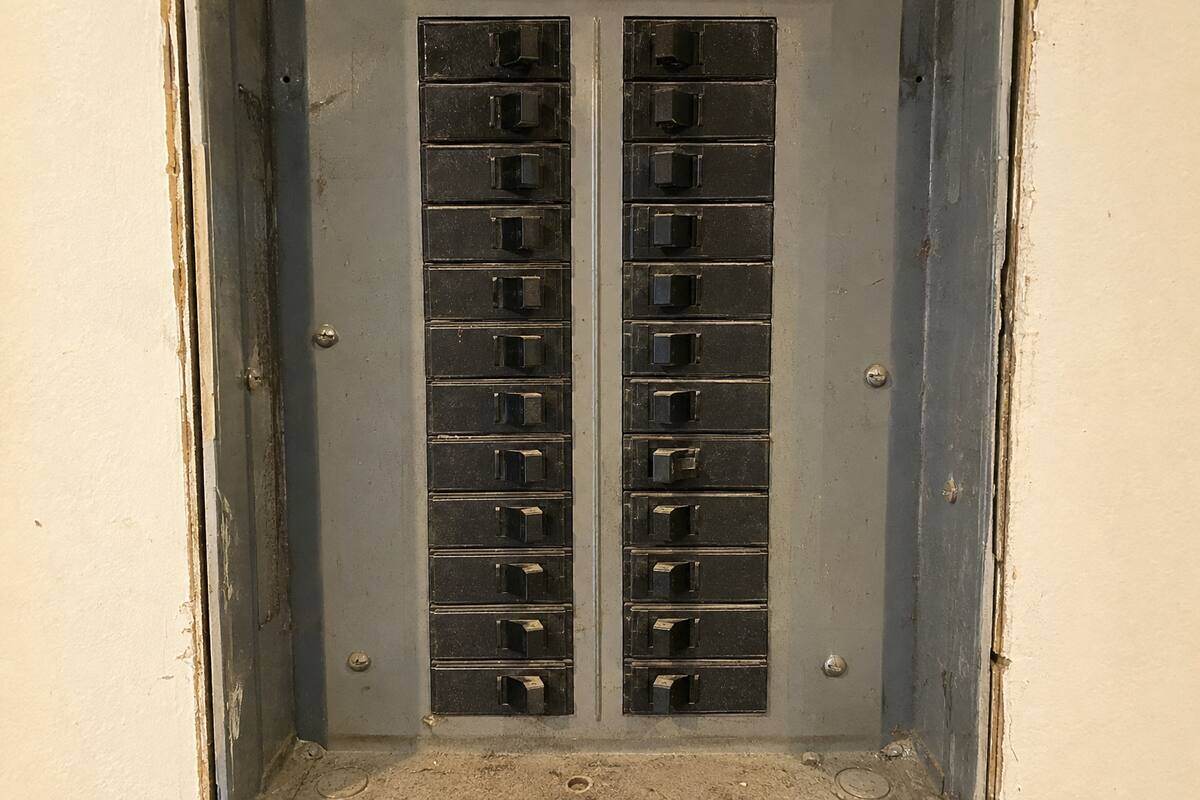
Most tripping breakers are an inconvenience to be diagnosed on a normal schedule. These are the versions that are not:
And the one that is not intuitive: a new arc-fault breaker that trips when the old breaker never did is usually correct. It is watching for arcing signatures the old breaker never looked for, so it finds loose terminals and damaged cable that an ordinary breaker would carry indefinitely. Treating it as a faulty new part is the wrong instinct. See GFCI, AFCI and code compliance.
Once, to see whether it holds. Not repeatedly. The breaker opened because current exceeded what that wiring can carry safely, and forcing it back defeats the only protection the circuit has. If it trips again immediately, leave it off and describe that on the call — it changes the diagnosis.
Compressor inrush. For a moment at startup the equipment draws several times its running current, and on an aged or undersized service that is where the margin runs out. It is a June-to-September complaint here for exactly that reason, and it can be an electrical problem, an equipment problem, or both.
Yes, and it is one legitimate answer among four. It is last on the list because assuming a nuisance trip when there is a genuine fault is how the fault stays in the wall. On a panel from a brand with a documented trip-failure history the reasoning runs the other way entirely.
Whether it trips instantly or after a while; what is running when it goes; whether it started after something changed in the house; and what the breaker is labeled. If you can read the brand inside the panel door, say that too.
Describe when it trips and what is running at the time. Getting connected with an independent, TDLR-licensed Fort Bend County electrician takes one call.
Call (346) 279-0855 Request a Quote Sugar Land