Home › Services › Whole-Home Generators
A standby generator is one of the largest additions a Fort Bend County house can take on — electrically, mechanically and financially. Get connected with an independent, TDLR-licensed electrician working in Sugar Land and Fort Bend County.
Most generator content sold in this region still runs on the memory of July 2024, when Hurricane Beryl left roughly 2.2 million CenterPoint customers without power. That was real. It is also four years ago, and the numbers since have moved in the other direction.
CenterPoint reported a 45% decrease in total outage minutes for the first half of 2025 against the same period in 2024, with 33% fewer vegetation-related outages, against a $3.2 billion systemwide resiliency plan running through 2029 — storm-resistant poles and several hundred miles of line moved underground. In January 2026 the company reported that more than 99% of customers kept power through a winter storm.
So the case for a standby generator in Sugar Land today is an insurance case, not a panic case. It is worth what it is worth to a specific household: someone on home oxygen or a CPAP, a home office that cannot go dark, a family that cannot decamp to a hotel, a house with a well or a lift pump. If that is you, the arithmetic is easy. If it is not, a generator is a large purchase against a risk that is measurably shrinking, and it is fair to say so.
Not a guess from square footage. What has to run, what can be shed, and whether one air conditioning system or two are in scope. This decides the unit size and most of the price.
The part that makes it a standby system rather than a generator. It isolates the house from the utility before the generator picks up, which is what stops a backfeed onto a line someone else is working on.
Usually the largest gas load added to the house since it was built. Meter capacity and pipe sizing have to carry it alongside the furnace, water heater and range simultaneously.
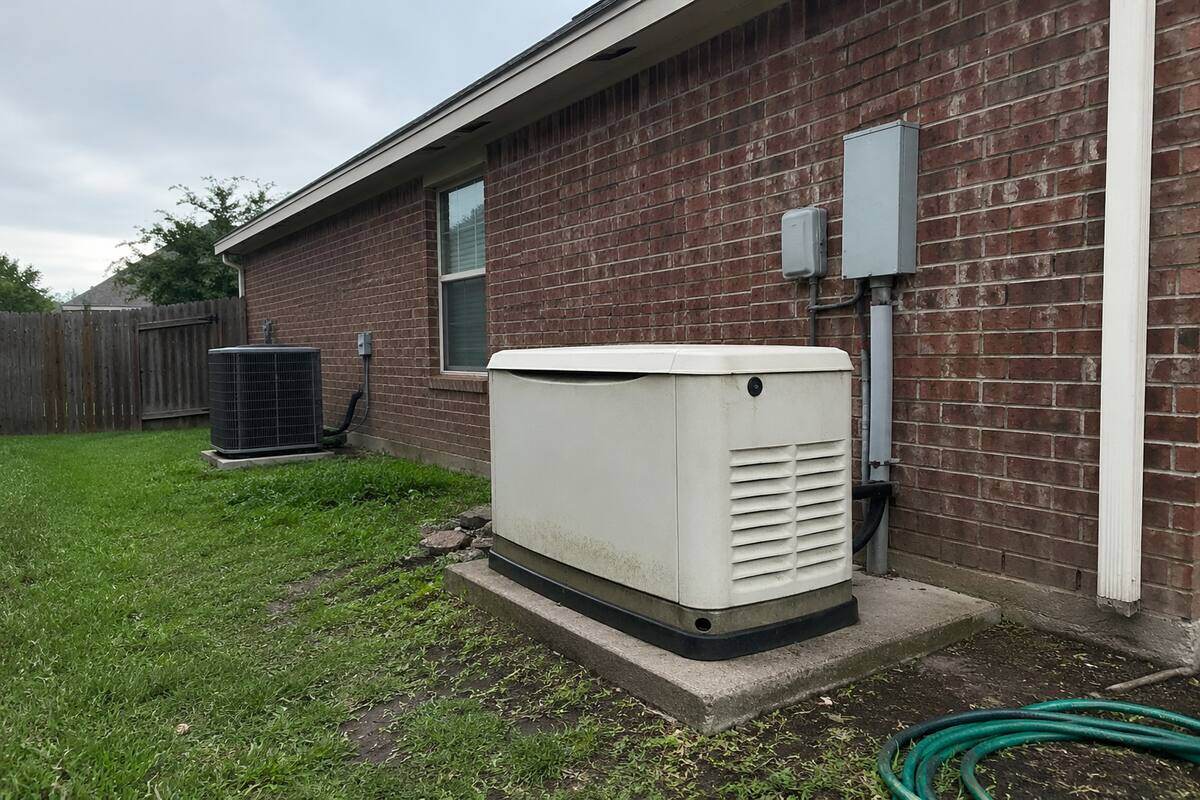
Slab-on-grade sites make the pad straightforward. Clearance from windows, doors and the meter, and exhaust direction, are code items. Permits in the Houston area generally run $400 to $1,400.
Installed cost for a residential standby unit in the Houston area typically lands between $9,500 and $16,000. The spread is mostly distance — from the gas meter, from the panel — plus whether the existing service needs work before it can take a transfer switch at all. On a 1970s house with an original 100A or 150A service, it often does. See panel upgrades.
Whole house or managed load? A managed transfer switch running refrigeration, some lighting, internet and one air conditioning system is a genuinely different product from covering everything, and it is much cheaper. In a two-system Sugar Land house, deciding to cover one system rather than both can move the unit down a size and take the gas supply question with it.
Where is the gas meter? On an estate lot in Sugar Mill or Venetian Estates, the run from meter to generator can be long enough to change the pipe size and the trenching cost. It is worth walking that line before the first quote.
What does the HOA require? Several Sugar Land communities have architectural review with specific rules about placement, screening and generator noise. That is not an electrical question, but it is the one most likely to move a unit ten feet and add a day.
What is the maintenance commitment? A standby unit exercises itself weekly, needs oil and filters on a schedule, and is a machine sitting outdoors in Gulf Coast humidity. Budget for that, not just for the install.
Typically $9,500 to $16,000 all in for a residential standby unit, with permits generally adding $400 to $1,400. Unit size drives the base, but the variable costs — the gas run, the electrical run, any service work required to accept a transfer switch — are what make two quotes on the same street differ by thousands.
Partial coverage through a managed transfer switch is common and considerably cheaper: refrigeration, selected lighting and outlets, internet, and one air conditioning system. Covering two AC systems plus everything else pushes both the unit size and the gas supply requirement up sharply. In this climate, "one AC system plus the fridge" is the coverage most households actually need.
Often, and it is the item most commonly missing from a cheap quote. A standby generator is usually the largest single gas load added to a house since construction, and the meter and piping must supply it at the same time as the furnace, water heater and range. Finding that out after the pad is poured is an expensive way to find out.
For some households, yes, at a fraction of the cost. It needs a properly installed inlet and a listed interlock or transfer switch so the generator can never backfeed the utility line — that is a licensed job and not a place to improvise — plus somebody at home to start it and keep fuel in it. That last requirement is usually what decides it, because outages are not scheduled around who is home.
Tell us which parts of the house have to keep running and roughly what the service is. Getting connected with an independent, TDLR-licensed Fort Bend County electrician takes one call.
Call (346) 279-0855 Request a Quote Sugar Land