Home › Services › GFCI, AFCI & Code Compliance
Ground-fault and arc-fault protection did not arrive everywhere at once. It arrived room by room, over fifty years, on the National Electrical Code's schedule — so the year a Sugar Land house was permitted tells you almost exactly what it has and what it does not.
They get spoken about together and they protect against opposite things.
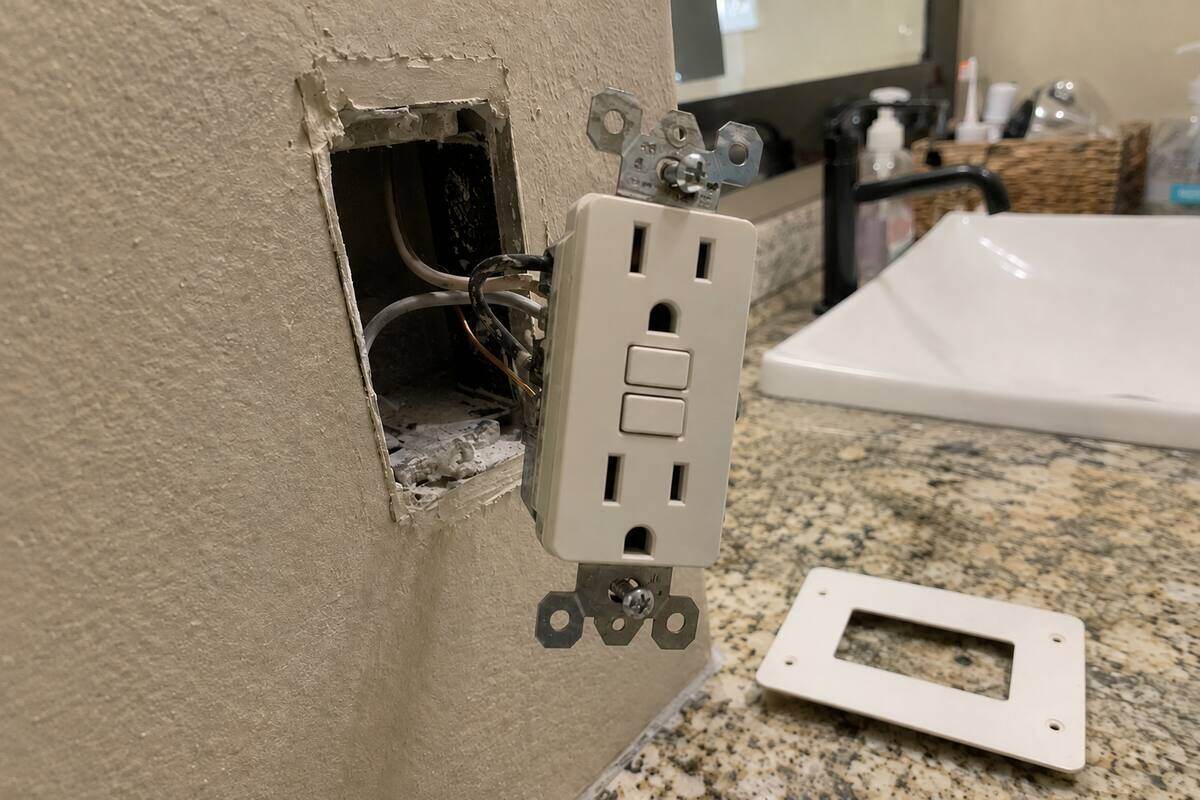
A GFCI — ground-fault circuit interrupter — watches for current leaving the circuit by an unintended path, which in practice usually means through a person to ground. It protects people, it acts in milliseconds, and it is why the code put it in wet locations first: outdoors, bathrooms, garages, kitchen counters.
An AFCI — arc-fault circuit interrupter — watches for the electrical signature of an arc: a loose terminal, a stapled-through cable, a chewed conductor, a cracked lamp cord. It protects the building. It went into bedrooms first because that is where people are asleep when a fire starts.
Neither replaces the other, and neither replaces an ordinary breaker's overload protection. A modern kitchen circuit may be carrying all three functions at once.
These are the National Electrical Code editions in which each requirement first appeared. Local adoption follows the national cycle with a lag, so treat them as the earliest a house could have been required to have it — not the day it appeared in Fort Bend County.
1971 — outdoor receptacles
1975 — bathrooms
1978 — garages
1987 — kitchen counter receptacles
2005 — laundry areas
2014 — dishwashers
January 1, 2002 — bedroom circuits, as an effective date rather than a code-cycle date
2008 — expanded well beyond bedrooms into most habitable rooms
2014 — kitchens and laundry rooms added
This is the part that is genuinely local, because Sugar Land's build eras are unusually clean and unusually well documented. Take three houses:
A 1978 house in Sugar Creek. Outdoor receptacles and the bathroom fall inside the requirement; garages had only just been added. The kitchen counters almost certainly have no ground-fault protection as built, because that was nine years away. There is no arc-fault protection anywhere, because that was twenty-four years away. Anything protected today was added later by somebody.
A 1994 house in New Territory. Kitchen and bathroom ground-fault protection as built, garage and exterior too. Zero arc-fault protection — the bedroom requirement was still eight years out. This is the single most common configuration in Sugar Land, because the 1980–1999 bloc is the largest slice of the city's housing.
A 2016 house in Riverstone. Both, essentially everywhere, including the 2014 additions of kitchen and laundry arc-fault and dishwasher ground-fault. Whatever this house's electrical problems are, they are not coverage problems.
You can check your own build year against the Fort Bend Central Appraisal District record for the address — it is public and free, and it is a better starting point than a guess from the architecture.
Electrical code is applied when a house is permitted. A later edition does not retroactively make an existing house illegal, and no inspector is going to require a 1994 house to be brought to 2023 standards because the calendar moved. What triggers current code is work: a circuit replaced, extended, or added is inspected against the code in force now, which in Sugar Land is the 2023 NEC, adopted along with the 2024 International Codes under Ordinance 2395. That adoption puts the city ahead of the Texas statewide residential minimum, which still rests on the 2015 IRC.
This is why a panel replacement in a 1990s house comes back with breakers the house never had, and why a kitchen remodel quote includes protection on circuits that were fine yesterday. It is not upselling. It is the inspection the work has to pass. See panel upgrades for how that lands on a quote.
The honest reason to add protection to an older house is not compliance at all. It is that a 1994 bedroom circuit runs through an attic that has spent thirty Gulf Coast summers above 130°F, past staples driven in by hand, in a house where somebody has since hung a ceiling fan. Arc-fault protection is a retrofit worth considering on its merits.
No. Code applies at the time of permitting, and a later cycle does not make an existing house non-compliant. Arc-fault protection reached bedrooms effective January 1, 2002, so a 1994 house never had it and was never required to. What changes the picture is new work, which is inspected against today's code.
Because it is almost certainly downstream of a ground-fault device somewhere else — commonly in a garage, a bathroom, or another exterior box behind a planter. A single GFCI receptacle can protect a whole string of ordinary outlets, and when it trips they all go dead with nothing visible at the panel. Finding the parent device is the first move, and in older Sugar Land houses it is frequently somewhere nobody would guess.
Plug something in, press TEST, and confirm the device trips and the power goes off; then press RESET and confirm it comes back. Manufacturers generally recommend monthly. A device that will not trip on test, or will not reset, has failed and is no longer protecting anything — a common finding on devices past about fifteen years, and worth knowing given how much of Sugar Land's protection hardware dates to the original build.
No, but it does force the work up to current code. Circuits replaced, extended or added are inspected against the 2023 NEC as adopted here, which is why a remodel quote often includes protection devices on circuits that previously had none. Untouched circuits elsewhere in the house are not affected.
Tell us the year the house was built and which rooms are giving you trouble. Getting connected with an independent, TDLR-licensed Fort Bend County electrician takes one call.
Call (346) 279-0855 Request a Quote Sugar Land