Home › Services › Outlets, Switches & Fixtures
The cheapest electrical work in the house is also where most of its faults eventually appear, because every one of these is a connection somebody made by hand thirty or forty years ago. Get connected with an independent, TDLR-licensed electrician working in Sugar Land and Fort Bend County.
A receptacle can be wired two ways: onto the screw terminals at the side, or pushed into small holes in the back. The push-in method — "backstabbing" — is faster, was standard practice in tract construction from the 1970s onward, and relies on a small spring contact holding the conductor.
Decades of load cycling in a house that runs air conditioning seven months a year loosens those contacts. When one fails, the outlet goes dead — and because receptacles on a circuit are frequently daisy-chained through these terminals, everything downstream goes with it. That is why a single failed device in a bedroom takes out three rooms and looks like a much bigger problem than it is.
A device replaced properly comes back on the screw terminals, or pigtailed, and the circuit stops depending on the device body to carry current through to the next outlet.
A ceiling fan needs a box listed for fan support. A standard fixture box is rated for static weight, not a rotating load. Fans hung from unrated boxes are one of the most common findings in 1980s and 90s Sugar Land houses.
The code limits conductors, devices and clamps per box volume. Older shallow boxes frequently exceed it once a modern device with more terminals goes in, which is why a "just swap the outlet" job sometimes becomes a box change.
Required in dwelling units for new and replacement work since the 2008 NEC. It is why a new receptacle does not look quite like the one that came out.
Replacing a receptacle in a location the current code requires to be ground-fault or arc-fault protected brings that requirement with it. See GFCI, AFCI and code compliance.
Gulf Coast humidity and driven rain are hard on exterior receptacles. A weatherproof cover that only seals when nothing is plugged in is not the one the code wants on a wet location.
In a house from the 1965–mid-70s window, swapping a device is not a routine job — the termination method is the whole question. See aluminum wiring remediation.
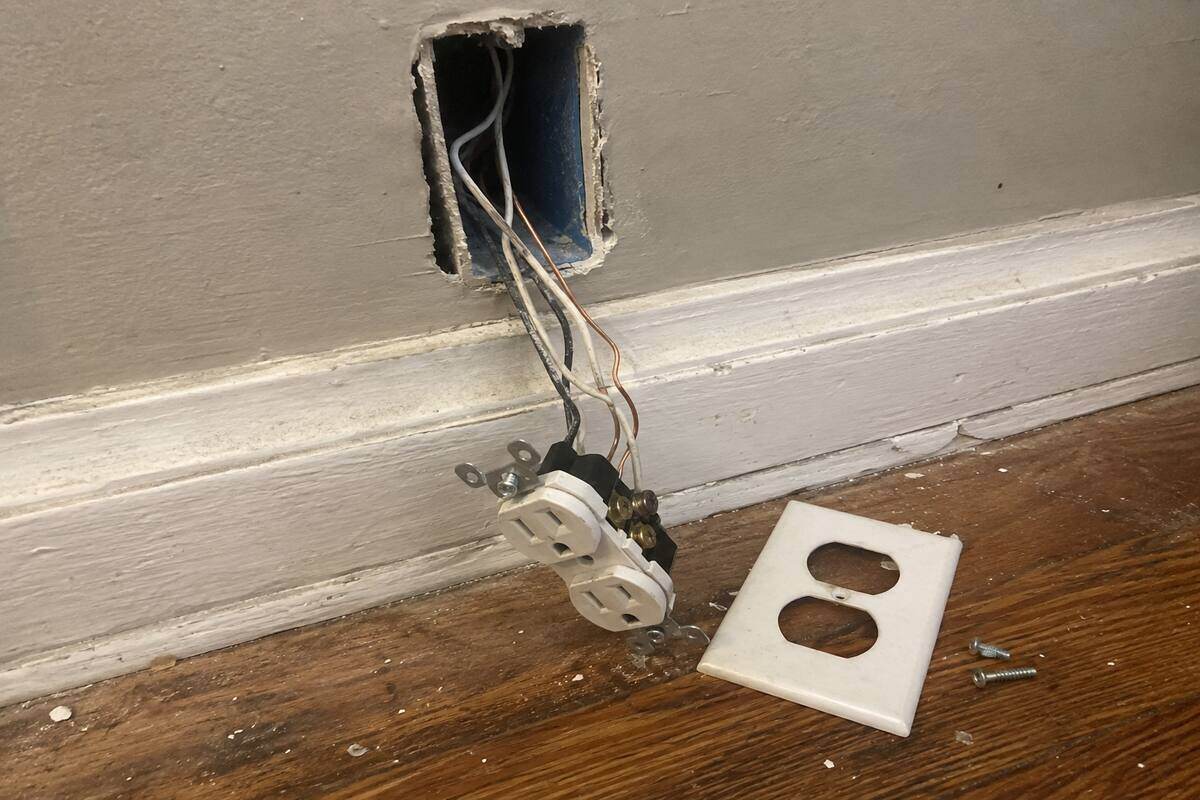
A receptacle wired through the push-in holes on the back instead of the screw terminals. Standard in tract construction, and a common cause of dead outlets decades later — the spring contact loosens with thermal cycling and eventually fails open, taking everything downstream with it.
No. A fan requires a box listed for fan support, because the load is dynamic rather than static. A fan on a standard fixture box is a routine finding in this housing stock and a routine correction.
For new and replacement work in dwelling units, yes — required since the 2008 NEC. Sugar Land's adopted code is the 2023 NEC, so any replacement done today carries the requirement.
Box fill. There is a limit on how many conductors, devices and clamps a given box volume may contain, and older shallow boxes often exceed it once a modern device goes in. An overfilled box is a heat and conductor-damage problem, so the correct fix is a bigger box rather than a harder push.
Tell us what stopped working and roughly when the house was built. Getting connected with an independent, TDLR-licensed Fort Bend County electrician takes one call.
Call (346) 279-0855 Request a Quote Sugar Land