Home › Services › Christmas Lights Tripping the Breaker
If it happens the first time it rains and not before, it is almost certainly not too many lights. It is water finding a path to ground, a ground-fault device doing precisely what it was installed to do — and, in a lot of Sugar Land houses, the garage door opener going down with it.
A ground fault. Water gets into a plug, a socket, or the joint where two strings meet, and gives current a path to ground it is not supposed to have. A ground-fault device watches the current going out against the current coming back, and when the two disagree by a few thousandths of an amp it opens the circuit in a fraction of a second. Nothing is broken. That is the device doing the one job it exists to do, and the reason it exists is that the alternative path to ground can be a person standing on wet grass.
An overload. Genuinely too much load on one circuit. This one is real but far rarer than people assume, and it behaves differently: it trips after the load has been on a while, it correlates with what you plugged in rather than with the weather, and it does not care whether anything is wet.
The distinction matters because the fixes have nothing in common. Swapping to LED strings solves an overload completely and solves a ground fault not at all.
Most of what is written about holiday lighting failures is written for markets with ice. Ours does not have ice. It has rain, fog and heavy overnight dew, in December, on connections that have been sitting outside since the weekend after Thanksgiving.
That changes the pattern in a way worth recognizing. The trip does not come on the coldest night; it comes on the wet one. It very often comes at dusk, because a timer or a photocell energizes the string at exactly the point where the day's rain is still sitting in every socket. And it repeats: the string dries out, resets fine, and goes again with the next front.
Ground-fault protection at outdoor receptacles has been a code requirement since 1971, so essentially every house in Sugar Land has it outside — including the oldest housing in Venetian Estates. Garages followed in 1978. Which means this is one of the few electrical questions on this site where the answer barely depends on the build year: almost everyone here has the protection, and almost everyone here eventually meets it in December.
This is the part that turns an annoyance into a bad evening, and it is a construction detail rather than a fault.
In most Texas tract houses the exterior receptacles, the soffit receptacles and the garage receptacles are all on one circuit, frequently protected by a single ground-fault device somewhere in that chain. Those soffit receptacles are often switched, and they were put there for exactly one purpose, which is holiday lighting. So a wet connection under the eaves opens a device in the garage, and everything downstream of it dies at once.
Whether that includes the door opener depends on when the house was built. The opener plugs into a ceiling receptacle, and older code allowed that receptacle to skip ground-fault protection precisely because it was not readily accessible. The 2008 code cycle removed that exception. So in a house permitted under the 2008 code or later — much of Riverstone and the later Telfair phases — the opener sits behind the same ground-fault protection as the lights. In an older house it may not; but if the breaker trips rather than the GFCI device, the opener goes down regardless.
No power at the opener means no clicker and no app. The emergency release cord is inside the garage. If the only other way into the house is a door you do not have a key for, a wet light string has just locked you out of your own house. It is worth knowing, before December, whether your door has an exterior emergency release lock, and worth having a house key somewhere you can actually get to.
Ground fault, almost certainly. Water in a connection. Look at what you reset: if a button popped out on a receptacle, that is a GFCI device, not a breaker.
Same thing, with a timer or photocell supplying the timing. The string energizes while the day's rain is still in it.
Overload. Count what is actually on that circuit — a garage freezer and a second refrigerator are the usual hidden passengers.
Neither. That is a fault in the wiring or a failed device, and it is not a seasonal problem. See a breaker that keeps tripping.
The device or the circuit, not the lights. Common on original 1990s protection hardware that has simply reached the end of its life.
Later houses often use a dual-function breaker in the panel rather than a receptacle, so the reset is at the panel — and it also watches for arcing, which a nicked or crushed cord will produce. See GFCI, AFCI and code compliance.
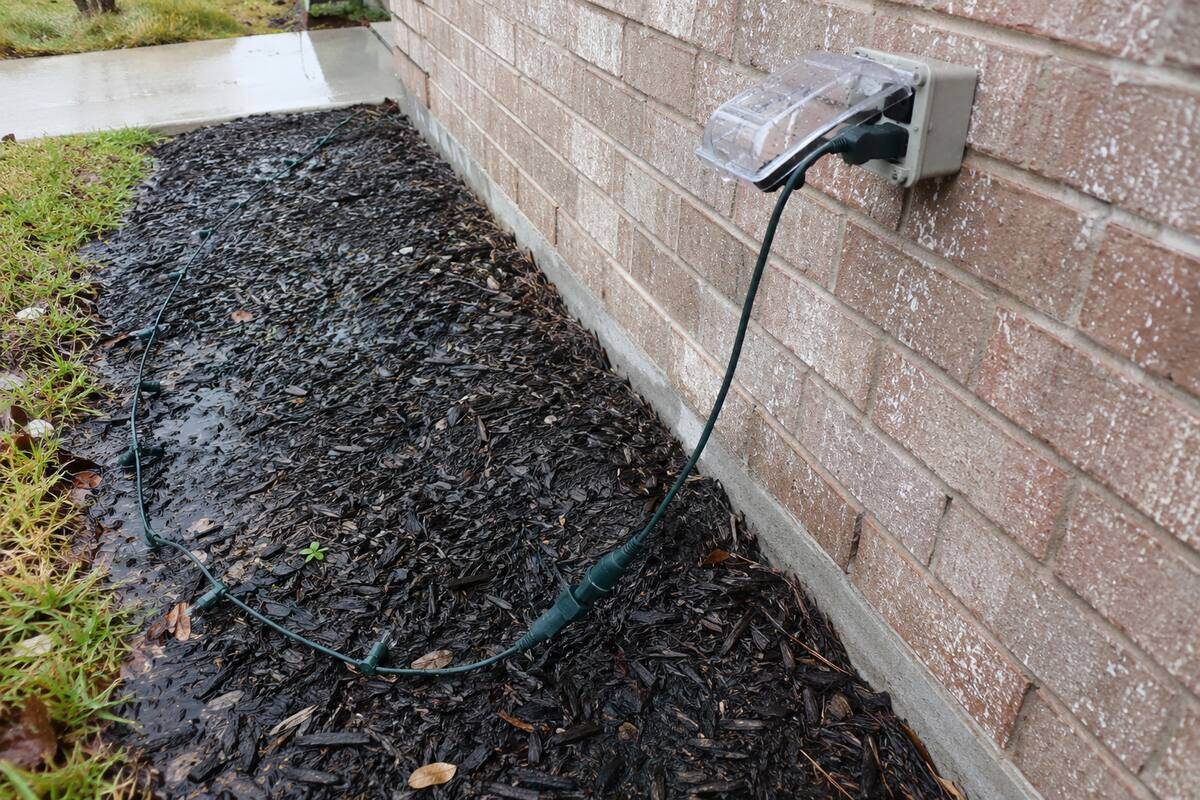
Keep the connections out of the water. Not clever, but it is most of the answer. Joints between strings belong up off the ground and out of standing water and mulch, not lying in the flower bed where the downspout discharges. A drip loop — letting the cord hang below the connection so water runs off rather than into it — costs nothing and prevents most of these trips.
Use the in-use cover. The bulky clear cover on an exterior receptacle that closes over a plugged-in cord is not decoration. Code requires wet-location receptacles to stay protected while something is plugged into them, and a flat flip-up cover that only seals when the receptacle is empty does not do that. If a cover is broken or missing, that is the cheapest repair on this page.
Use outdoor-rated cords and respect the tag. Every string is marked with how many sets may be connected end to end. Incandescent strings run out at a handful; LED strings usually allow many more. Exceeding it is the overload version of this problem.
Convert to LED for the load, not for the water. LED strings draw roughly a tenth of what incandescent C9 strings do. If the trip is an overload, that ends it. If it is a ground fault, a wet LED connection trips exactly the same way.
And if it happens every single year, stop treating it as weather. A house that loses its garage every December is telling you the circuit layout does not match how the house is used. The durable fixes are electrician-level work: splitting the soffit and exterior receptacles onto their own circuit, moving the reset somewhere reachable instead of behind a shelf in the garage, replacing protection hardware that is thirty years old, or adding a properly protected exterior circuit sized for seasonal load. See outlets, switches and fixtures and panel upgrades.
Because it is a ground fault, not an overload. Water in a plug, a socket or a joint gives current a path to ground, and a GFCI opens the circuit in milliseconds when it sees that imbalance. The trip follows the weather rather than the number of lights, which is the giveaway.
Because the exterior receptacles, the soffit receptacles and the garage receptacles are usually one circuit behind one ground-fault device, so everything downstream of it dies together. In houses permitted under the 2008 code or later the opener's ceiling receptacle is behind that protection too — the exception that had allowed it to skip protection was removed in that cycle. And if the breaker itself trips, the opener is dead in any house.
It fixes an overload outright and does nothing whatsoever for a ground fault. Diagnose which one you have first, or you will spend a weekend restringing the house and meet the same trip on the next wet night.
The emergency release cord works from inside only. From outside it comes down to a keyed entry door, or an exterior emergency release lock if your door was fitted with one. Both are worth establishing in November rather than in the rain in December — along with keeping a house key somewhere you can genuinely reach.
Resetting a ground-fault device after the string dries out is normal and expected. Repeatedly forcing it back on while the fault is still present is not, and neither is bypassing it — the device is there because wet outdoor lighting and people on wet ground are the exact case it was invented for. If it will not hold with everything unplugged, leave it and get it looked at.
Say what trips, whether it follows the rain, and what else on the house goes dead with it. Getting connected with an independent, TDLR-licensed Fort Bend County electrician takes one call.
Call (346) 279-0855 Request a Quote Sugar Land