Home › Services › No Power in Half the House
Some rooms fine, others completely dead, and nothing at the panel looks tripped. This has three or four plausible explanations, and telling them apart matters because one of them is a genuine emergency and the others are not.
A house here is fed by two 120-volt legs that combine to give 240 volts for the large appliances. Breakers alternate between them down the panel. So if one leg is lost — at the utility, at the meter, at the main lugs, or at a feeder — roughly half the circuits go dead and the other half carry on as though nothing happened. That distinctive "half the house" pattern is what points at the service rather than at a branch circuit.
Utility side, at the drop or the meter. Neighbors may be fine; this is your service, not the neighborhood's. CenterPoint owns the drop, the meter and the disconnect regardless of who bills you for energy, so reporting it to them is the right first move.
Inside the panel, at a termination that has loosened and overheated over decades. More likely on older equipment, and a reason not to keep switching things on to test.
One GFCI protecting outlets across several rooms. Common in older Sugar Land houses where the parent device is behind an appliance, in a garage, or in an exterior box. Cheapest possible outcome — look for it first.
Some breakers trip to a middle position that does not read as "off" at a glance. Firmly off, then on, is the test — once.
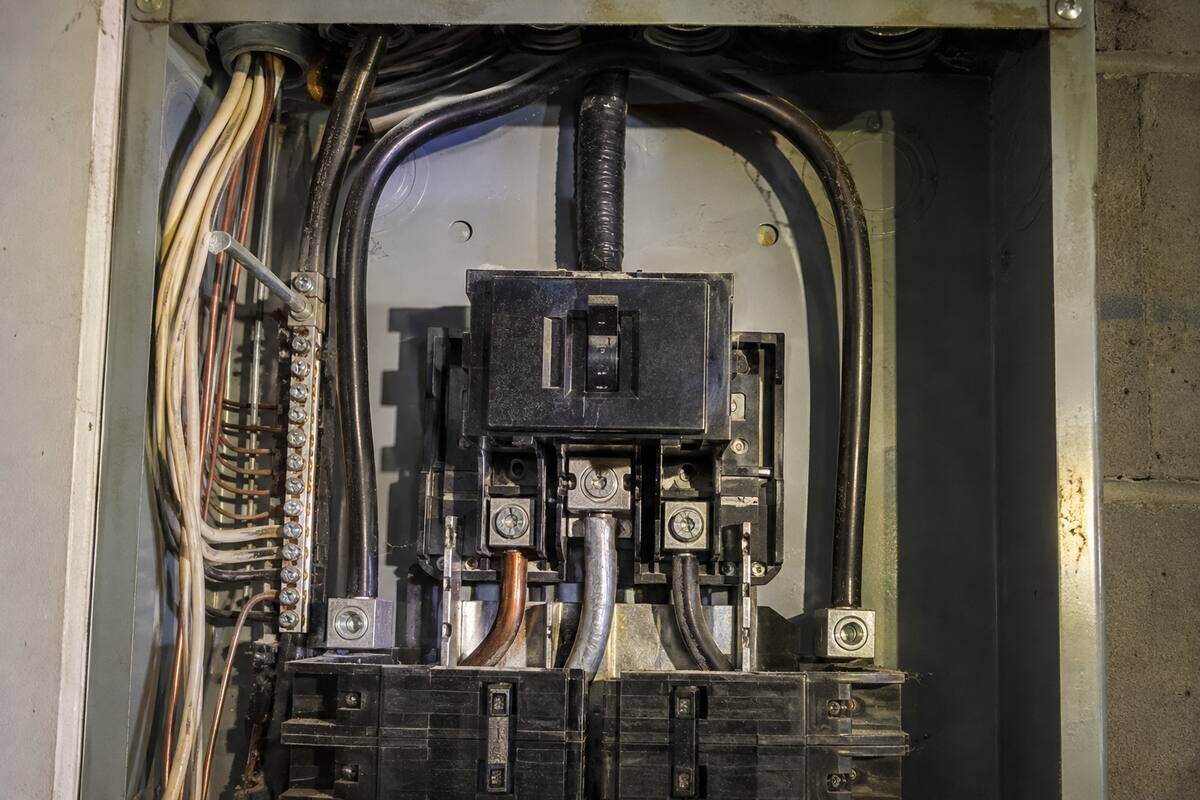
If part of the house is dim or things are running slowly, while another part has lights burning unusually bright, flickering with load, or bulbs failing repeatedly — stop.
That pattern points at a lost or loose neutral. The neutral is what keeps the two legs balanced at 120 volts each. Without a solid one they divide according to whatever load happens to be on each side, so some circuits sit well above 120 volts. Electronics fail quickly, motors and transformers overheat, and it is a fire risk rather than an inconvenience.
The correct response is to switch off the main breaker if you can safely reach it, and get a licensed electrician and CenterPoint involved immediately. This is not the failure to wait out until Monday morning.
Note which rooms are affected — and whether the pattern follows rooms or follows circuits. Check whether any 240-volt appliance also failed: an electric range, a dryer, an air conditioning system. That is a strong signal for a service-side problem. Look for a tripped GFCI in the garage, bathrooms and exterior boxes and press RESET once. And note whether it began during or after a storm, or after any work on the house.
What not to do: do not remove the panel's inner cover, and do not run the house on extension cords from the working half for days. Both are common and both make things worse. See repair and troubleshooting.
Most commonly a lost leg of the incoming service, a failed main lug or feeder connection, or a tripped device feeding a string of outlets. The half-the-house pattern is what distinguishes a service-level problem from a branch circuit.
A lost or loose neutral, and it is the urgent case. The two legs stop being held at 120 volts each and divide by load instead, so part of the house is overvoltage. Switch the main off if you can do so safely and call immediately.
Both are reasonable, and reporting it to CenterPoint costs nothing. They own the service drop, the meter and the disconnect no matter which retail provider bills you, so a fault on their side is theirs to fix. A licensed electrician determines which side of the meter the problem is on.
It can kill everything downstream of it, which in older houses is regularly more outlets, in more rooms, than anyone expects. It is the cheapest possible answer, so it is worth ruling out before assuming the worst.
Say which rooms are out, whether any 240-volt appliance is affected, and whether anything is running oddly bright. Getting connected with an independent, TDLR-licensed Fort Bend County electrician takes one call.
Call (346) 279-0855 Request a Quote Sugar Land